The meaning of 'right' and 'wrong'
For this topic, the minimum you would want to know is the following:
Most people agree that some human actions can be classified as ‘right’ or ‘wrong’.
However, there is little agreement about what these words actually mean, and therefore when they have been applied correctly.
Here we examine two possible meanings of ‘right’ and wrong’.
Divine Command Theory
John Calvin argues that an act is ‘right’ if God commands it, and ‘wrong’ if God forbids it.
He explains, ‘The will of God is the supreme rule of righteousness, so that everything which he wills must be held to be righteous by the mere fact of his willing it’ (1559, p. 227).
He argues that because God is perfectly good, God would only ever command people to do right; therefore, instead of trying to figure out ‘right’ and ‘wrong’ for ourselves, we should submit to God’s commands.
Utilitarianism
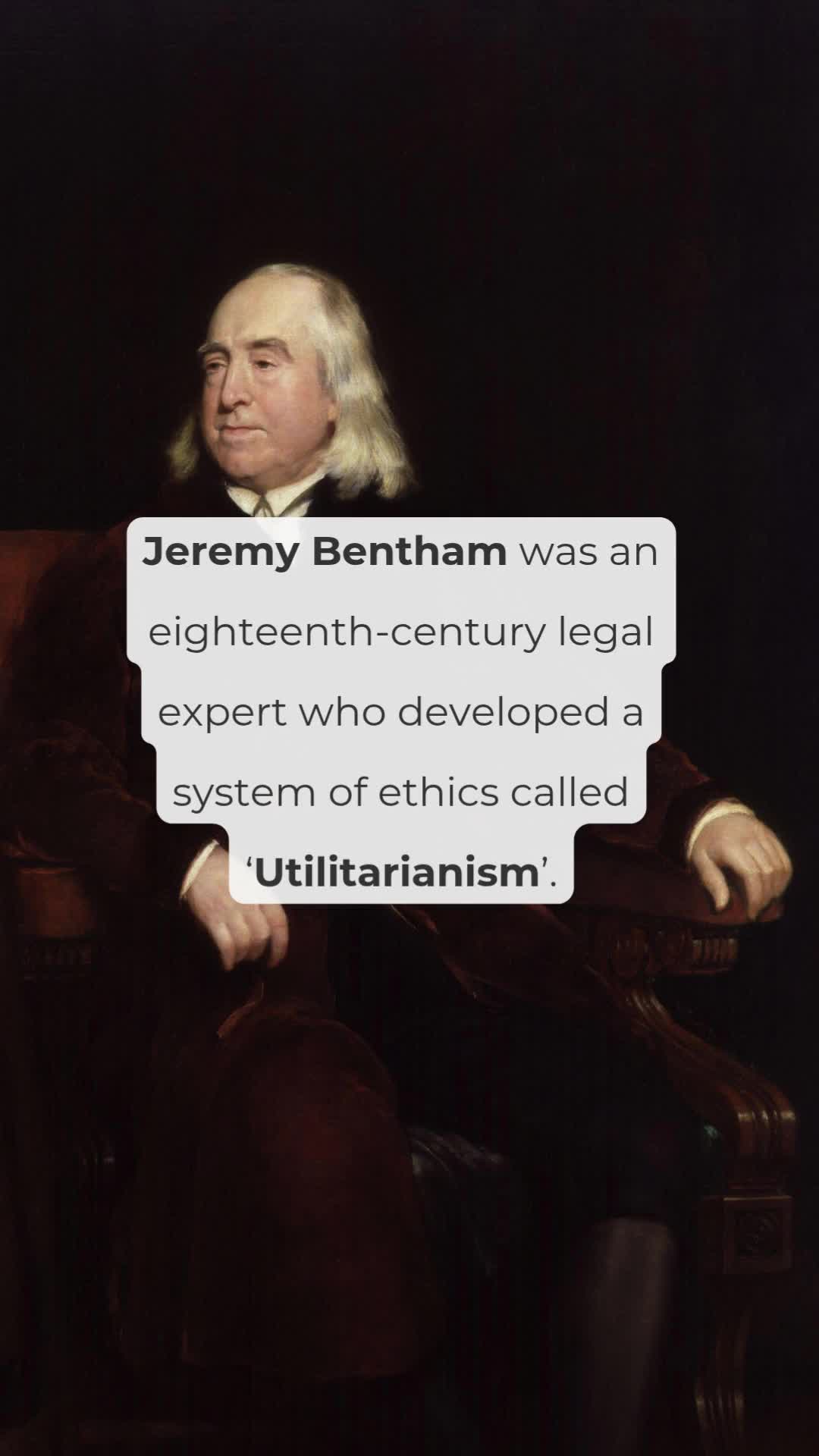
Jeremy Bentham argues that an act is ‘right’ if it leads to pleasure, and ‘wrong’ if it leads to pain.
He explains that, ‘the standard of right and wrong, and the chain of causes and effects, are both fastened to their throne’ (1823, p. 6).
He means that pleasure is the only thing that is intrinsically good: everything we do is done either because it is pleasurable, or because it will eventually lead to pleasure. Therefore, what is ‘right’ is what leads to a state of pleasure.
Intuitionism
G.E. Moore argues that an act is ‘right’ if it leads to a situation that is ‘good’.
However, he explains that ‘“good” is a simple notion, just as “yellow” is a simple notion; that, just as you cannot, by any manner of means, explain to any one who does not already know it, what yellow is, so you cannot explain what good is’ (1903, p. 59).
Because ‘good’ is a simple, unanalysable property, we simply know intuitively whether a situation is ‘good’ or an act is ‘right’.
References:
Bentham, Jeremy. 1823 [2017]. An Introduction to the Principles of Morals and Legislation, ed. Jonathan Bennett, Early Modern Texts <https://www.earlymoderntexts.com/assets/pdfs/bentham1780.pdf> [accessed 30 May 2026]
Calvin, John. 1559 [1845]. Institutes of the Christian Religion, Book 3, trans. Henry Beveridge, Christian Classics Ethereal Library <https://ccel.org/ccel/calvin/institutes/institutes.> [accessed 30 May 2026]
Moore, G.E. 1903 [1993]. Principia Ethica, revised edition (Cambridge)