Kant's Ethics
For Kant’s Ethics, you would want to know at least the following:
Immanuel Kant was an eighteenth-century philosopher.
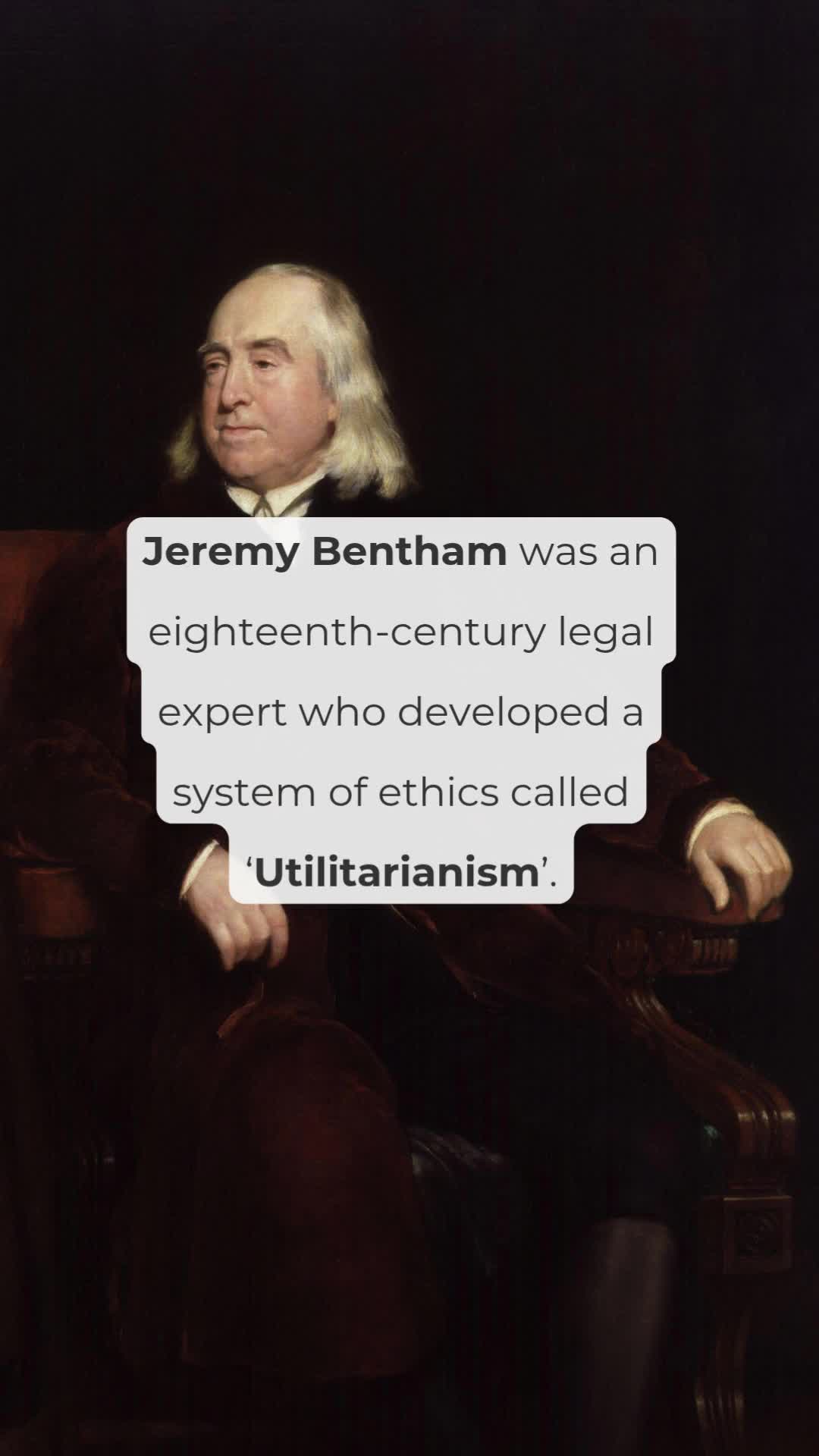
He was skeptical of ethical systems (like Bentham’s ‘Utilitarianism’) that derived ‘right’ and ‘wrong’ from experience.
It did not make sense to him that a moral rule (e.g. ‘do not kill’) could be ‘right’ in one situation and ‘wrong’ in another.
Instead, Kant proposed a series of tests that could be used to identify moral rules that were ALWAYS right.
Here, we examine two of these tests.
‘Universalisability’
Kant argued that if a moral rule was truly ‘right’, then it should be possible to live in a world where everyone always followed it.
He explains, ‘Act only in accordance with that maxim through which you can at the same time will that it become a universal law’ (1785 [2025]: 43).
He means, if you have a ‘maxim’ (i.e. a personal plan or rule) to achieve some end, imagine everyone in the world went about it in the same way.
If in such a world your plan would be impossible, then what you are considering doing is WRONG.
For example, suppose you wanted to borrow money but not repay it.
Imagine a world where no one EVER repaid what they borrowed.
In such a world, no one would lend money at all, and you would not be able to get the money you need (Kant 1785 [2019]: 36).
This tells you that your ‘maxim’ / plan is wrong — borrowing money without intending to repay it is NEVER right.
‘Ends not Means’
Kant also argued that it is never right to use people as an object or tool to get what you want.
Kant explains ‘Act so that you use humanity, as much in your own person as in the person of every other, always at the same time as end and never merely as means’ (1785 [2025]: 44).
He means that humans have intrinsic value and free will.To not obtain their consent for something, or to bypass their free will in any way, can never be right.
Consider again the example of borrowing money without intending to repay it.
This certainly benefits you, but only because you lied: the moneylender did not consent to losing their money.
You are using the moneylender merely as a ‘means’ to your happiness, without considering what they might have chosen for themself (Kant 1785 [2019]: 43).
It follows that a ‘lying promise’ is ALWAYS wrong.
References:
Frye, John, Debbie Herring, and Mel Thompson. 2017. Religious Studies for A-Level Year 2 (Hodder), pp. 196–223
Kant, Immanuel. 1785 [2019]. Groundwork for the Meta-Physics of Morals, trans. Christopher Bennett, Joe Saunders, and Robert Stern (Oxford)
———. 1785 [2025]. Groundwork for the Meta-Physics of Morals, in Anthology: A-Level Religious Studies, issue 3, Pearson, pp. 42–44
Scruton, Roger. Kant: A Very Short Introduction (Oxford), pp. 73–95
Tweed, Cressidia and Amanda Forshaw. 2019. Religious Studies: Religion and Ethics (Hodder), pp. 80–82